Lecture notes for JMW Turner
The Art of the Sublime
While Winckelmann was awakening neo-classicism in France, Edmund Burke was laying the roots of Romanticism in Britain. In his “A Philosophical Enquiry into the Origin of Our Ideas of the Sublime and Beautiful”, published in 1757 he defined the sublime as that which produces “the strongest emotion which the mind is capable of feeling.” and he linked this with the power of God.
Burke compared beauty with the sublime:
“..the sublime and beautiful are built on principles very different, and that their affections are as different: the great has terror for its basis, which, when it is modified, causes that emotion in the mind, which I have called astonishment; the beautiful is founded on mere positive pleasure, and excites in the soul that feeling which is called love.”
Joshua Reynolds was inspired by Burke's ideas and used his annual “Discourses on Art” to instruct the members of the Royal Academy in these:
“The sublime impresses the mind at once with one great idea; it is a single blow...” (Fourth Discourse 1771)
Reynolds also linked art to beauty and beauty to God:
“This idea of the perfect state of nature, which the artist calls the ideal beauty, is the great leading principle by which works of genius are conducted. ...
This is the idea which has acquired, and which seems to have a right to the epithet of Divine; as it may be said to preside, like a supreme judge, over all the productions of nature; appearing to be possessed of the will and intention of the Creator, as far as they regard the external form of living beings.”
This was an entirely different approach from the neo-classicism being taught across the Channel. Joseph Mallord William Turner was to become one of the most successful and devoted exponents of the sublime in art, especially the role of light and colour in creating the sublime.
As Burke put it:
“..the cloudy sky is more grand than the blue; and night more sublime and solemn than day”.
“..darkness is more productive of sublime ideas than light.”
“Extreme light, by overcoming the organs of sight, obliterates all objects, so as in its effect exactly to resemble darkness”
“...the light and glory which flows from the Divine presence; a light which by its very excess is converted into a species of darkness:—“
Joseph Mallord William Turner 1775–1851

Turner's father came from South Molton in Devon, he moved to London to become a barber and wig maker. He married Mary Marshall. Turner was born in Covent Garden on or around 23rd April 1775. He had a younger sister but she died, aged 4, in 1783.
In his early years he had a cockney accent that he never lost in later life.
In 1785, aged 10, William was sent to live with his uncles in Brentford. This may have been because his mother was suffering from mental illness. (In 1799 Turner's mother was committed to a lunatic asylum and was transferred to Bethlem Hospital (Bedlam) in 1800).
William moved to Margate in 1786 and went to school there. His artistic ability was obvious from an early age and his father sold his drawings in his shop.
He entered the Royal Academy in December 1789 at the age of 14. Sir Joshua Reynolds chaired the panel that admitted him.
He worked for architects and draughtsmen and sold landscape paintings to pay for his education. He was particularly influenced by Thomas Malton, an architectural painter, whom he called “my real master”. William also painted scenery for the stage and developed a love of opera.
From 1794 to 1797 he worked for Dr Monro, at three shillings and sixpence a day, tinting outline copies of works by Canaletto, Cozens and other artists. Dr Monro was the King's Doctor and subsequently treated Turner's mother when she became insane.
William quickly realised that there was money to be made from watercolour paintings of landscapes recording important tourist spots and from the 1790s onwards would tour in the summer, painting scenes en plein air, and staying in the studio in the winter.
(Bristol used to have its own Hot Springs but when the Portway was blasted out of the Avon Gorge to provide the road to Avonmouth it dried up.)
The Royal Society of Arts awarded Turner the “Great Silver Pallet” for landscape painting in 1790.
He sent his topographical pictures to engravers for reproduction in magazines such as the Pocket Magazine and the Copper Plate Magazine.
William exhibited watercolours at the Royal Academy from 1790 onwards and exhibited his first oil painting in 1796. This was called “Fishermen at Sea”.
Fifth Plague of Egypt
Turner attracted wealthy patrons, at first to paint their country estates, but later to support his work. William Beckford bought “The Fifth Plague of Egypt” and the Duke of Bridgewater commissioned “Dutch Boats in a Gale”.
The Fifth Plague of Egypt is actually a picture of the seventh plague - the one composed of hail and fire. It is gothic and romantic and displays a stylistic confidence that is ahead of its time.
The principle influence on Turner during the 1790s was probably the "Discourses" of Sir Joshua Reynolds.
Turner saw the Divine and Sublime in light. He is reputed to have said on his deathbed: 'The Sun is God'. In Fishermen at Sea and the Fifth Plague of Egypt we can see Turner's early attempts at portraying the sublime.
In 1799 Turner was elected an Associate of the Royal Academy and in 1802 was made an Academician. He produced a self portrait at this time:
It was also in 1799 that he devoted time to studying “Liber Veritatis”, a book of 200 mezzotints of Claude Lorraine's paintings by Richard Earlom. Claude Lorraine was a leading, French, seventeenth century landscape painter.
In 1802, during the Peace of Amiens, Turner was sponsored by a group of aristocrats to visit Paris and tour the Swiss Alps.
His own gallery
In 1804 he opened his own gallery on the corner of Harley St and Queen Anne's St. The gallery could hold up to 30 works. The gallery attracted collectors and admirers and led to a close relationship between Turner and three particularly well-heeled collectors: Walter Fawkes, The 3rd Earl of Egremont and Sir John Leicester. Turner was invited to paint landscapes by these collectors:
In the early 1800s he seems to have started a relationship with Sarah Danby, a widow who had two daughters, Evelina and Georgiana. These daughters may have been Turner's children although there is speculation that they were his fathers daughters.
His painting became increasingly stylised during the 1800s and he was accused of painting “crude blotches” by Benjamin West, the President of the Royal Academy.
However, Turner himself was on a quest, he wrote in 1810: 'To select, combine and concentrate that which is beautiful in nature and admirable in art is as much the business of the landscape painter in his line as in the other departments of art.'
Despite the criticisms Turner was appointed the Professor of Perspective at the Royal Academy in 1808. In 1806 he began his Liber Studiorum, a book of prints in which he classified landscape painting and described its history.
In 1807 Turner designed and built a house in Twickenham called “Sandycombe Lodge” where he retreated to paint. His father also lived in the house and acted as cook and gardener.
In 1813 Turner visited Devon and painted the landscape. “Crossing the Brook” shows the Tamar valley in an Italianate style:
He also showed that he could paint in the grand classical style:
In 1817 Turner visited the battlefield at Waterloo and in “The Field of Waterloo” painted the loss and torment of war rather than the victory:
In 1819-20 the collectors Fawkes and Leicester opened their collections of Turner paintings to the public to considerable acclaim.
Turner travelled to Italy in 1819 and again in 1828 and travelled through Northern France in multiple visits from 1821-1832. He had made acquaintance with King Louis Phillippe of France when he was in exile in Twickenham and visited him when he became King of France.
He published his paintings in books of prints that were marketed as “Turner's Annual Tour”.
During this period he produced paintings for engravings in several travel books and provided illustrations for books by Scott, Campbell and Byron.
Turner became fearless and would paint as the mood caught him:
His painting became adapted to the mood of the subject. In “The Fighting Temeraire” he records the last voyage of a warship that had taken part in the Battle of Trafalgar, using the mists and setting sun to paint the emotion of the moment:
The Fighting Téméraire
By Sir Henry Newbolt
…...
There's a far bell ringing
At the setting of the sun,
And a phantom voice is singing
Of the great days done.
There's a far bell ringing,
And a phantom voice is singing
Of renown for ever clinging
To the great days done.
Now the sunset breezes shiver,
Téméraire! Téméraire!
And she's fading down the river,
Téméraire! Téméraire!
Now the sunset's breezes shiver,
And she's fading down the river,
But in England's song for ever
She's the Fighting Téméraire.
Turner's Method of Painting
When creating a larger work he would compose numerous sketches and bring them together in the studio, often to illustrate a poetic theme.
His method was quite “ad hoc”, he even mixed oil and watercolour in the same painting:
‘When those same works were packed to be sent to England, I advised him to have the cover covered with waxed cloth, as the pictures without it might be exposed to wet. Turner thanked me, and said the advice was important; “for”, he added, “if any wet gets to them, they will be destroyed.” This indicates his practice of preparing his pictures with a kind of tempera, a method which, before the surface was varnished, was not waterproof [in fact analysis has not revealed any tempera, though Turner did quite often use watercolour on his oils and in at least one case, No. 300, a picture apparently from this group seems to have suffered losses to its water-soluble glazes]. The pictures referred to were in fact not finished; nor could any of his exhibited pictures be said to be finished till he had worked on them when they were on the walls of the Royal Academy’ (Catalogue entry for “Regulus” http://www.tate.org.uk/art/artworks/turner-regulus-n00519/text-catalogue-entry )
Even more extraordinary, he was known to have stuck paper cut outs to his pictures:
He sold “The Golden Bough” to Robert Vernon. “Two or three years after Vernon bought the picture his nephew Vernon Heath noticed that a figure in the foreground was splitting away. Turner went to see the picture ‘and in an instant exclaimed, “Why, this is only paper! I now remember all about it. I determined, the picture being all but finished, to paint a nude figure in the foreground, and with this intention went one night to the Life School at the Royal Academy, and made a sketch in my note-book. Finding, next day, that it was the exact size I required my figure to be, I carefully, by its outline, cut it out of the book and fixed it on to the picture, intending, when I had time, to paint the figure in properly. But I forgot this entirely, and do not think I should have remembered but for you.” ... The Sybil picture was then sent to Queen Anne Street and the present figure painted in.’ “ (Catalogue entry for “The Golden Bough” http://www.tate.org.uk/art/artworks/turner-the-golden-bough-n00371/text-catalogue-entry )
Even more surprising than his “ad hoc” approach to painting are his sketchbooks.
Turner the Man
Turner had a cockney accent all of his life and was quick witted enough to make his own living from an early age. Although happy with solitude he had a wide circle of friends and travelled frequently, often for long periods.
As a young man Turner gave the public appearance of someone totally lost in his art. An acquaintance described him in 1798:
'I recollect Turner as a plain uninteresting youth both in manners and
appearance, he was very careless and slovenly in his dress, not particular what
was the colour of his coat or clothes, and was anything but a nice looking young
man...He would talk of nothing but his drawings, and of the places to which he
should go for sketching. He seemed an uneducated youth, desirous of nothing
but improvement in his art...'
In private he seems to have been a different person:
Clara Wells, the daughter of William Wells, a Turner family friend recalled:
'Of all the light-hearted, merry creatures I ever knew, Turner was the most so;
and the laughter and fun that abounded when he was an intimate in our cottage
was inconceivable, particularly with the juvenile members of the family. I
remember coming in one day after a walk, and when the servant opened the
door the uproar was so great that I asked the servant what was the matter. 'Oh,
only the young ladies (my young sisters) playing with the young gentleman
(Turner), Ma'am.' When I went into the sitting room, he was seated on the
ground, and the children were winding his ridiculously long cravat round his neck;
he said, 'See here, Clara, what these children are about!'.
Turner is recorded as having great generosity of spirit, as Ruskin recounts:
“There was a painter of the name of Bird, and when
Bird first sent a picture to the Academy for exhibition,
Turner was on the hanging committee. Bird's picture
had great merit ; but no place for it could be found.
Turner pleaded hard for it. No, the thing was impos-
sible. Turner sat down and looked at Bird's picture a
long time ; then insisted that a place must be found for
it. He was still met by the assertion of impracticability.
He said no more, but took down one of his own pictures,
sent it out of the Academy, and hung Bird's in its place.”
“At the death of a poor drawing-master, Mr. Wells, whom Turner had long known, he was deeply affected, and lent money to the widow until a large sum had accumulated. She was both honest and grateful, and after a long period was happy enough to be able to return to her benefactor the whole sum she had received from him. She waited on him with it ; but Turner kept his hands in his pocket. " Keep it," he said, " and send your children to school and to church." He said this in bitterness ; he had himself been sent to neither.”
Ruskin. ' Lectures on Architecture
and Painting.' Lecture iii.
Society was rigidly divided by class in the nineteenth century and in his 50s Bill seems to have tired of upper class and academic attitudes. The upper classes always treat the lower classes as caricatures to avoid any sense of responsibility and this seems dishonest to anyone who has a wider experience.
What was Turner like as a man? We know he was a City of London Man, able at obtaining employment and advancement, sociable enough to be part of aristocratic gatherings, sophisticated enough to rise to the highest ranks of the Royal Academy. A man who had made a personal fortune of at least £15 million at today's values and who was welcome in the Court of Kings. A man who was more travelled and experienced than almost any of his contemporaries. However, because he had a cockney accent and poor background he is always at risk of being caricatured as some sort of oaf, especially by the British.
Miss Danby and Mrs Booth
Turner took on a housekeeper, Hannah Danby, in the 1820s. She had two children by him, Eveline and Georgiana. She also developed a severe skin disease that disfigured her. In the film “Mr Turner” the script writers divide Miss Danby into two characters, Miss Danby and a housekeeper with a serious skin condition. In his will, Turner appointed Hannah Danby as ‘Custodian and Keeper of the Pictures House and Premises 47 Queen Anne Street’ and left her £150 per annum to keep the Gallery ‘in a viewable state at all times.’ (4)
In 1833 at the age of 58 Turner began staying at Margate with Sophia Caroline Booth whose husband died in that year. Turner had been at school in Margate and had visited the town often so it is possible that this was an old acquaintance re-awakened. After Turner's death Mrs booth told the artist David Roberts that “"...for about 18 years they lived together as husband & wife, under the name of Mr & Mrs Booth ... But the most extraordinary part of her naritive [sic] is that, with the exception of the 1st year he never contributed one Shilling towards their mutual support." Turner carried on the relationship “in cognito” and called himself “Admiral Booth”. Turner also left Mrs Booth £150 per annum in his will and directed that she should be jointly responsible with Miss Danby for his estate.
His relationship with Mrs Booth along with dark hints about erotica in his sketchbooks has been cited as evidence of moral degeneracy. However, even the more extreme of Turner's erotic pictures are scarcely in this category:
William kept his relationship with Mrs Booth a secret, especially from his housekeeper, Mrs Danby:
“His old housekeeper, Mrs. Danby, was in
painful anxiety about the place of his retreat, and dis-
covered it by accident. ' One day/ says Mr. Thornbury,
' as she was brushing an old coat of Turner's, in turning
out a pocket, she found and pounced on a letter directed
to him, and written by a friend who lived at Chelsea.
Mrs. Danby, it appears, came to the conclusion that Turner
himself was probably at Chelsea, and went there to seek
for him, in company with another infirm old woman.
From inquiries in a place by the river-side, where ginger-
beer was sold, they came to the conclusion that Turner
was living in a certain small house close by, and informed
a Mr. Harper whom she and Turner knew. He went to
the place and found the painter sinking. This was on
the 18th of December, 1851, and on the following day
Turner died. “
There are many descriptions of Turner's affairs with Miss Danby and Mrs Booth. Consider this Victorian account by Hamerton that displays the classism of the time:
“We all know the pictures of Titian and his mistress, and his portraits of
her, yet nobody talks of the immorality of Titian ; but Turner's domestic arrangements with Mrs. Danby and Mrs. Booth give more acute pain to our sense of propriety because they seem more degrading.”
 |
| Turner in his early 60s |
Turner's Artistic Legacy
"A group of French painters, united in the same aesthetic aims...applying themselves with passion to the rendering of form in movement as well as the fugitive phenomena of light, cannot forget that they have been preceded in this path by a great master of the English, the illustrious Turner." (from a letter signed by Monet, Pissarro, Degas, Renoir, and others referenced in A History of British Art, By Andrew Graham-Dixon).
However, in many ways William Turner was unique. He was succeeded in Britain by the Pre-Raphaelites who reacted against the philosophy of Reynolds and his generation by placing realism above the sublime.
“The Fallacies of Hope”
Turner accompanied many of his paintings with a verse that explained the scene. He described all of these verses as “Fallacies of Hope”. This seems to have been a joke, an allusion to some gigantic epic poem that ranges from descriptions of the Thames through references to Hannibal to steam ships. No such epic poem has ever been found. It is more likely that each picture has its own poem that was a condensed description for the catalogue.
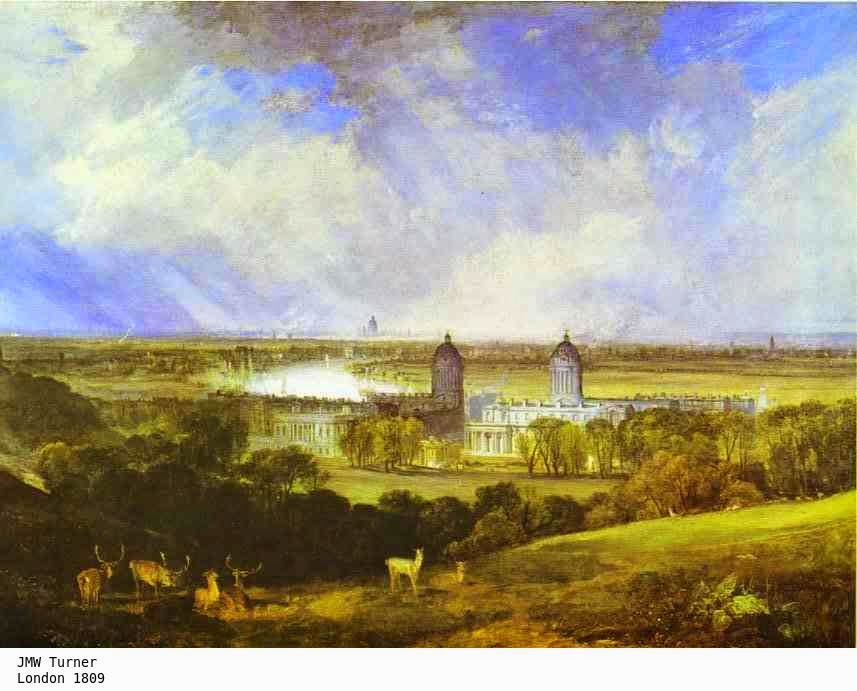
London from Greenwich Park exhibited 1809
http://www.tate.org.uk/art/artworks/turner-london-from-greenwich-park-n00483/text-catalogue-entry
Where burthen'd Thames reflects the crowded sail,
Commercial care and busy toil prevail,
Whose murky veil, aspiring to the skies,
Obscures thy beauty, and thy form denies,
Save where thy spires pierce the doubtful air,
As gleams of hope amidst a world of care.
The Fall of an Avalanche in the Grisons exhibited 1810
http://www.tate.org.uk/art/artworks/turner-the-fall-of-an-avalanche-in-the-grisons-n00489/text-catalogue-entry
‘The downward sun a parting sadness gleams,
Portenteous lurid thro' the gathering storm;
Thick drifting snow on snow,
Till the vast weight bursts thro' the rocky barrier;
Down at once, its pine clad forests,
And towering glaciers fall, the work of ages
Crashing through all! extinction follows,
And the toil, the hope of man—o'erwhelms.’
Caligula’s Palace and Bridge exhibited 1831
http://www.tate.org.uk/art/artworks/turner-caligulas-palace-and-bridge-n00512/text-catalogue-entry
‘What now remains of all the mighty Bridge
Which made the Lucrine Lake an inner pool,
Caligula, but massy fragments left,
As monuments of doubt and ruind hopes
Yet gleaming in the Morning's ray, doth tell
How Baia's shore was loved in times gone by?’
The Sun of Venice Going to Sea exhibited 1843
http://www.tate.org.uk/art/artworks/turner-the-sun-of-venice-going-to-sea-n00535/text-catalogue-entry
‘Fair Shines the morn, and soft the zephyrs blow,
Venezia's fisher spreads his painted sail so gay,
Nor heeds the demon that in grim repose
Expects his evening prey.’
Peace - Burial at Sea exhibited 1842
http://www.tate.org.uk/art/artworks/turner-peace-burial-at-sea-n00528/text-catalogue-entry
‘The midnight torch gleamed o'er the steamer's side
And Merit's corse was yielded to the tide.’
Snow Storm: Hannibal and his Army Crossing the Alps exhibited 1812
http://www.tate.org.uk/art/artworks/turner-snow-storm-hannibal-and-his-army-crossing-the-alps-n00490/text-catalogue-entry
Craft, treachery, and fraud—Salassian force,
Hung on the fainting rear! then Plunder seiz'd
The victor and the captive, —Saguntum's spoil,
Alike, became their prey; still the chief advanc'd,
Look'd on the sun with hope;—low, broad, and wan;
While the fierce archer of the downward year
Stains Italy's blanch'd barrier with storms.
In vain each pass, ensanguin'd deep with dead,
Or rocky fragments, wide destruction roll'd.
Still on Campania's fertile plains—he thought,
But the loud breeze sob'd, “Capua's joys beware!”’
Turner also used short excerpts from other poets to describe his paintings:
Morning amongst the Coniston Fells, Cumberland exhibited 1798
http://www.tate.org.uk/art/artworks/turner-morning-amongst-the-coniston-fells-cumberland-n00461/text-catalogue-entry
Ye mists and exhalations, that now rise
From hill, or steaming lake, dusky or gray,
Till the sun paint your fleecy skirts with gold
In honour to the world's great Author, rise.
Milton Paradise Lost Book V
THE LIFE OF J. M. W. TURNER, R.A. PHILIP GILBERT HAMERTON,
https://archive.org/stream/lifeofjmwturnerr01hame/lifeofjmwturnerr01hame_djvu.txt
Turner. Eric Shanes. http://www.turnersociety.org.uk/Turner_biography.pdf
Seven Discourses on Art. 1768-1775. Sir Joshua Reynolds. http://www.gutenberg.org/files/2176/2176-h/2176-h.htm
https://archive.org/stream/jmwturner00chiguoft/jmwturner00chiguoft_djvu.txt
4. Jack Lindsay. J.M.W.Turner – his Life and Work, 1966, p.216)
THE LIFE OF J. M. W. TURNER, R.A.
FOUNDED ON LETTERS AND PAPERS FURNISHED BY
HIS FRIENDS AND FELLOW-ACADEMICIANS
WALTER THORNBURY https://archive.org/stream/lifejmwturnerra01thorgoog/lifejmwturnerra01thorgoog_d